COMMUNICATIONS TECHNOLOGY SAVES THE AIRLIFT
For the airlift to succeed, Britain and the US had to continuously land aircraft loaded with supplies in Berlin. However, winter weather prevented the cargo planes from seeing the runways and landing. Ground Control Approach (GCA) provided an air traffic controller with radar that could track an aircraft’s location in flight, despite any weather. The controller, talking over the radio to the pilot, used that information to describe what the plane needed to do to land safely. GCA’s ability to “talk down” pilots proved critical to the success of the Berlin Airlift.

The simple-looking radar stations allowed air traffic controllers to find aircraft in the clouds and use radar to safely guide the planes to the runway. This CPN-4 GCA was used at Tempelhof in Berlin.
COMMUNICATION AS THE FORCE MULTIPLIER
The difference between a group of aircraft and an air force is the ability to unite the individual planes through a common network, share the capabilities of unique systems across the force, and maintain command and control of a mission. The difference is the science of communications. Often simply called “Comm,” Communications Airmen build and operate the unseen network that unites the Department of the Air Force’s tremendous airpower. Their work can place them on the leading edge of both combat and science.
“Without communication, the only thing I control is my desk.” - General Thomas Power, Commander in Chief, Strategic Air Command.
COMMUNICATIONS ADVANCES AIRMANSHIP
The Army’s first pilots’ daring feats of aviation demonstrated airpower’s capabilities. They also identified where technology could standardize and improve the
infrastructure of early airfields across the country. Early investments in communication focused on delivering navigation and weather information aviators needed to fly safely.

1923-AIR ALERT NET, WEATHER DISSEMINATION
The United States Army Air Service established radio stations that provided air to ground communications and weather information across the country.
.jpg?ver=6y2WbjEXXegPDbBkQnWghQ%3d%3d)
1934-LONG DISTANCE FLIGHT FROM WASHINGTON D.C. TO ALASKA AND BACK
Lieutenant Colonel Henry “Hap” Arnold led a flight of ten B-10 bombers on a demonstration flight that proved airpower’s reach and capability by flying across North America. It took five days to reach Fairbanks and four days to return.
1938-ARMY AIRWAYS COMMUNICATIONS SYSTEM (AACS) CREATED
Among other things, AACS operated fixed Air Corps radio control towers for ground and air communications. The system provided weather reports, navigational aids, and flight plans to pilots in flight.

1938-AACS BUILDS HIGHWAYS IN THE SKY
AACS created a separate military airway system that divided the country into three regionally controlled zones. Each region’s commander was responsible for meteorological, airway, and airdrome control.
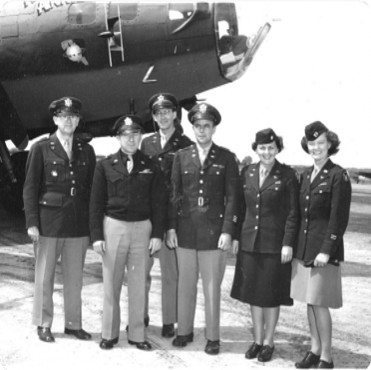
1940-ARMY AIR FORCES FLIGHT CHECK MISSION
In a specially modified B-17, an AACS crew flew throughout the world validating the accuracy of navigational aids. These systems made instrument flight possible.
1941-FACSIMILE (FAX) TRANSMISSION OF WEATHER DATA
The United States Army Air Forces (USAAF) transmitted facsimiles and radio facsimiles of weather maps and maritime data. Faxing a single map took roughly 20 minutes across the AACS system.
1944-GROUND CONTROL APPROACH (GCA) DEVELOPED
Faced with unpredictable English weather, the USAAF needed a way to safely recover aircraft in limited visibility. The Mobile GCA unit’s search and precision radar allowed Air Traffic Controllers to land planes in any weather.

1945-AIRBORNE NETWORKING
During World War II, General Harold Grant commanded a specialized C-47 that, once landed, acted as a mobile command post for the Supreme Allied Commander of Southeast Asia.
NETWORKING THE AIR FORCE
The need to develop a system of communication that transmits information across distances or battlefields is fundamental in unifying the promise of airpower. From the signal flares and telegraph wires of the early Air Service to the futuristic satellites and integrated networks of today, the Department of the Air Force has always been on the leading edge of information integration.

1910-FIRST RADIO COMMUNICATION BETWEEN GROUND AND AIR
In 1910, the Army transmitted the first radio message from an aircraft, and by the end of the decade, the Army Signal Corps could communicate to and from aircraft while in flight.

1945-THE FIRST COMPUTER
The Department of War ordered the construction of the first large-scale electronic speed computer during World War II. The Electronic Numerical Integrator and Computer (ENIAC) weighed 30 tons and could quickly compute complex mathematical equations.

1959-AUTOMATIC DIGITAL NETWORK (AUTODIN)
AUTODIN used an automatic, electronic system of transistors to connect different USAF bases and other Department of Defense organizations. The system was installed and operated by the Air Force Communication Service (AFCS) and delivered digital message traffic around the world.
EXPEDITIONARY COMMUNICATIONS
From combat zones to natural disasters, Airmen are expected to deploy into austere and dangerous situations to install and operate their communications gear in support of the Department of the Air Force’s (DAF) mission.
CONNECTING THE MODERN BATTLESPACE
Not all aircraft have the same capabilities, but the most advanced aircraft’s technology can be shared across the force through equally sophisticated communications networks.
Click here to return to other Exhibits